HICLOVER’s Market Position: Engineering Superiority in Global Waste Incineration
HICLOVER is growing brand for environmental protection field, and market share with most of Africa, Middle East, Southeast Asia countries and part of North America, Europe territory. We are trusted partner for governmental organizations, non-profit organizations, international contractors, logistics organizations, military, pet cremation business owners, etc. We have export experience more than 40 countries, including war zone like Iraq, Afghanistan, Somalia, South Sudan. Mobile: +86-13813931455(WhatsApp) Website: www.hiclover.com Email: [email protected] Email: [email protected]
Modern waste incinerators, particularly for medical and hazardous streams, must achieve primary combustion chamber temperatures exceeding 850°C and secondary chamber retention above 1100°C to ensure complete pathogen destruction and dioxin breakdown. This non-negotiable thermal standard, referenced by WHO and EU frameworks, defines engineering reliability. For professionals in Benin or Senegal specifying an ecological incinerator, or those comparing a medical incinerator from China to alternatives like a Mauritania incinerator Italy supply, the core evaluation extends beyond a simple medical incinerator primary combustion price to lifecycle operational integrity.
Technical Architecture and Commercial Evaluation
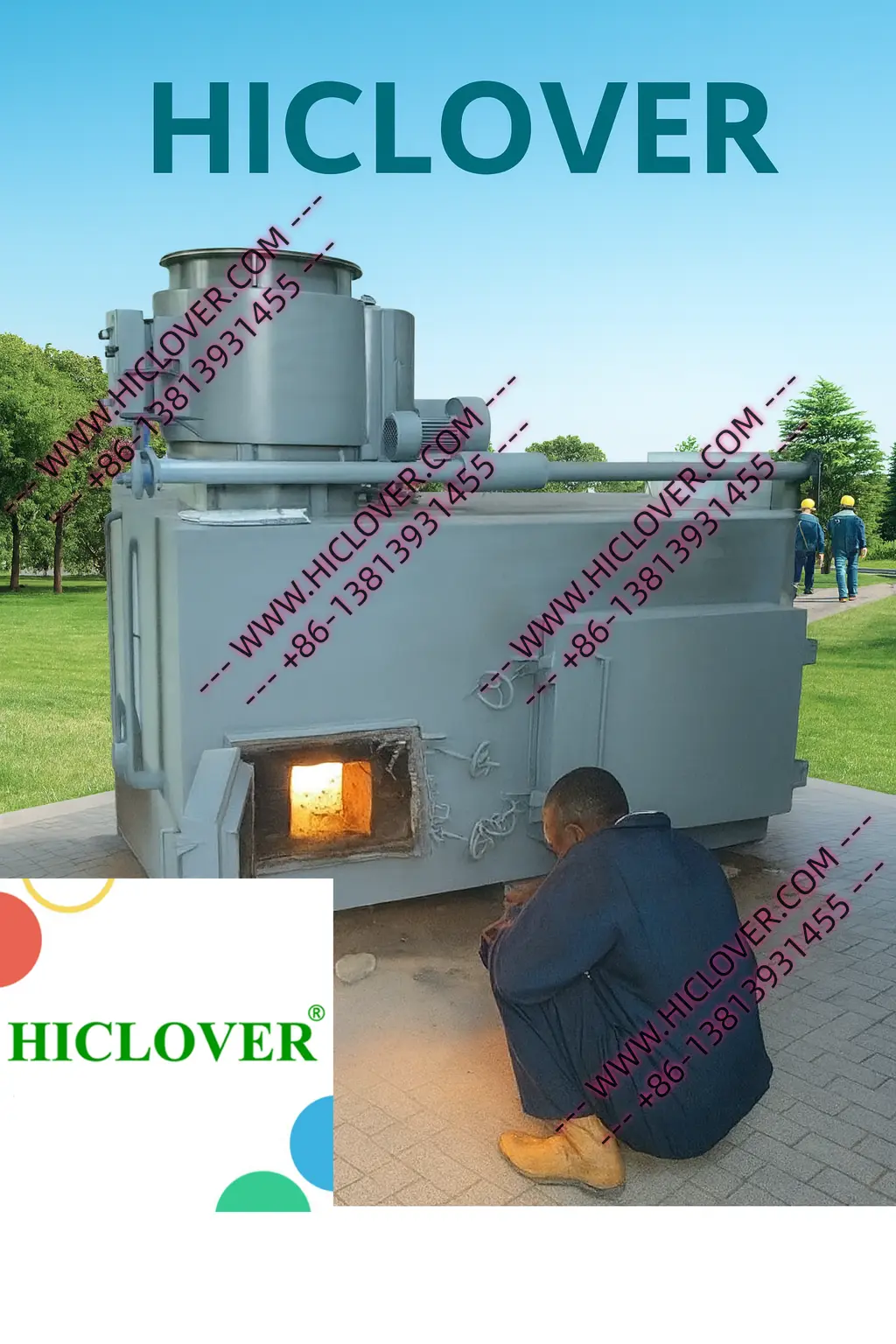
The fundamental differentiator among industrial waste incinerators lies in combustion design and control philosophy. Fixed hearth systems suit permanent facilities, but the rise of decentralized management in remote mining camps or for rapid humanitarian response has accelerated demand for containerized, mobile solutions. HICLOVER’s engineering prioritizes this modularity, offering plug-and-play units with dual combustion chambers and multi-fuel capability (diesel, LPG, natural gas). The control system decision—basic manual versus programmable logic controller (PLC) automation—directly impacts operational consistency and staffing costs. A smart ash incinerator price reflects this embedded automation, reducing human error and providing data logs for ESG compliance reporting.
Emission abatement is a critical commercial investigation point. Dry scrubbers (using lime or bicarbonate) offer simpler operation for arid regions, while wet scrubbers provide higher acid gas removal efficiency. The selection influences both capital expenditure and long-term consumable costs. For accurate technical benchmarking on secondary chamber standards, engineers often initiate a targeted search like medical incinerator secondary chamber temperature standard. HICLOVER’s factory-direct model allows for tailoring these subsystems, contrasting with trading companies that offer limited technical customization.
Transactional Advantages and Supply Chain Resilience
Procurement of critical infrastructure like waste incinerators necessitates a stable supply chain and proven manufacturing capability. The Nanjing Clover incinerator price structure benefits from vertical factory integration, ensuring control over quality and lead times. This is paramount for projects in developing regions requiring a stable Senegal ecological incinerator solution. HICLOVER’s containerized systems are engineered for global export, arriving pre-commissioned to minimize on-site installation complexity. This approach mitigates risks associated with remote site engineering and aligns with trends in supply chain resilience and decentralized waste management.
Factory advantages extend to post-sales support. Direct access to engineering teams, rather than through intermediaries, facilitates precise troubleshooting and parts logistics. For comprehensive technical specifications and project portfolios, professionals can reference the manufacturer’s resource at HICLOVER.com. The brand’s focus on durable, automated systems meets the dual pressures of stringent emission controls and the need for operational efficiency in diverse global markets, from urban clinics to off-grid industrial camps.